FACT: In the information network of the human brain, there could be more points of connection than there are stars in the Milky Way.
The galaxy is home to more than 100 billion stars – maybe as many as 400 billion. Regardless of the precise count, those inconceivable numbers pale in comparison to the trillions (roughly estimated as 100 trillion) of synaptic connections between brain cells, or neurons. Synapses are the spaces over which neurons send and receive electrical and chemical signals. The brain’s magical ability to learn, and to recall information already learned, depends on synapses.
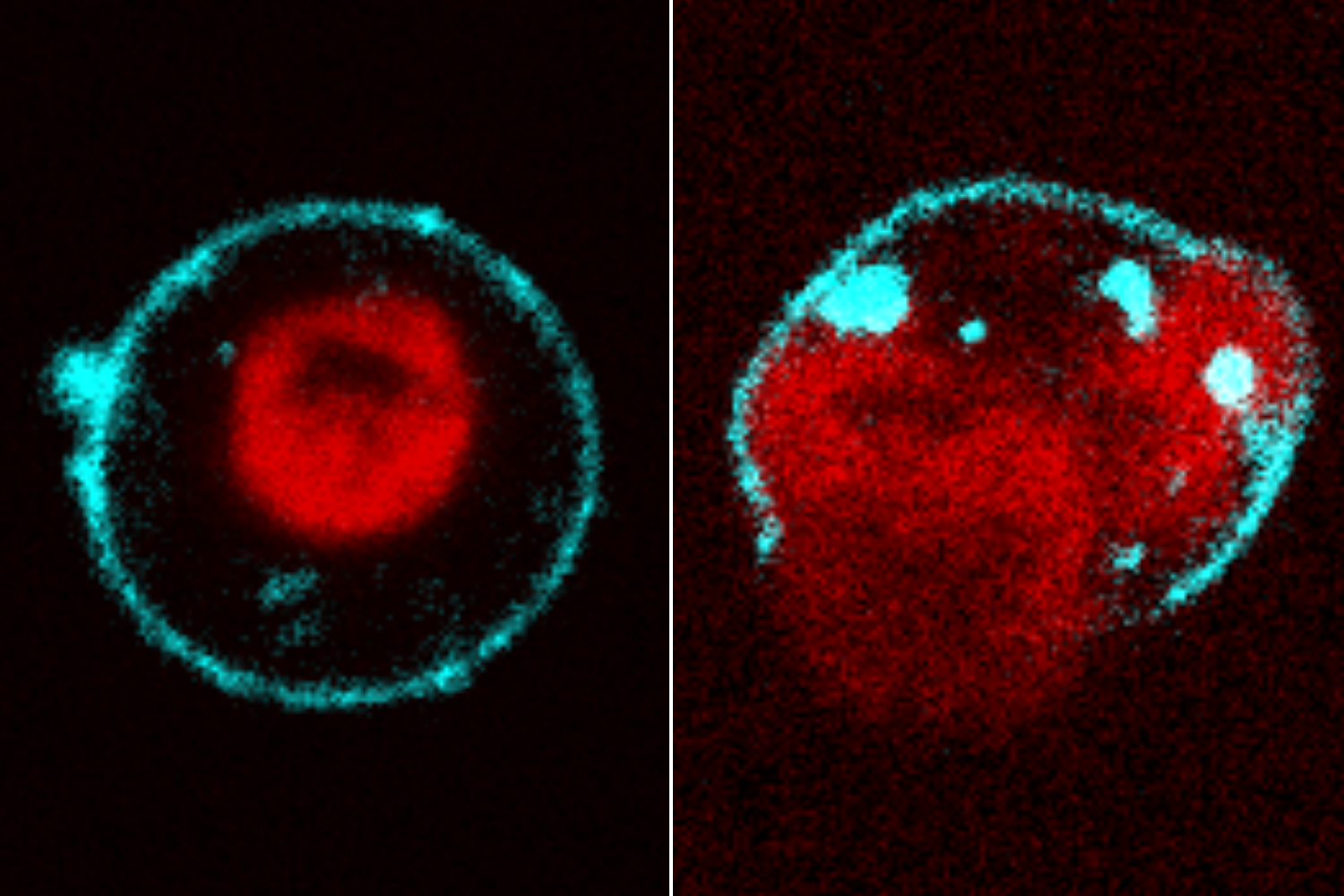
Eager to advance computer technology, Stanford University materials scientist Alberto Salleo and his colleagues first developed an artificial version of the brain’s synapse almost a decade ago. To build the synapse, they used organic semiconductors, which are synthetic, inexpensive materials that can both conduct and block electricity. This work can help develop brain-inspired – or “neuromorphic” – computers, brain-machine interfaces, medical devices, and new research tools for neuroscience. Most recently, the scientists showed that a biohybrid edition of their artificial synapse can communicate with living cells.
More research from the Salleo Research Group
“The artificial synapse can be used for what people call ‘brain-like computing,’ performing mathematical operations that are currently very energy inefficient in a way that’s much more energy efficient,” said Salleo, who is also deputy director for science and technology and chief research officer at SLAC National Accelerator Laboratory (SLAC) . “This is a big theme because as the demand for computation goes up, the demand for energy goes up even more. It’s becoming a major drain on the energy resources and, of course, creating all sorts of other environmental problems.”
Salleo’s lab also uses organic semiconducting materials to develop other types of flexible electronics, like wearable medical devices. Salleo is the first to admit that the field of materials science is obscure for most. He explained that it combines approaches from chemistry, physics, and biology and evolved out of metallurgy, the study of metals. Historically, Stanford transformed its metallurgy program into the Materials Science and Engineering Department. In his new role at SLAC, Salleo is excited to facilitate multidisciplinary science and technology developments like these and bring together the unique expertise of Stanford and the national lab.
“Most people don’t know what a materials scientist does,” Salleo said. “We are the descendants of metallurgists in many ways. But as materials scientists, we work with every material, focusing on how to treat and process them to tease out the best properties.”


For more information
Salleo is the Hong Seh and Vivian W. M. Lim Professor, a professor of materials science and engineering in the School of Engineering, a professor in the Photon Science Directorate at SLAC, a member of Stanford Bio-X and the Wu Tsai Neurosciences Institute, and an affiliate of the Precourt Institute for Energy.
Writer
Anna FitzGerald Guth